Quick price summary: Dentists in Sydney (2026)
- Low end: $60 – $180 (basic check-up and clean at a bulk-billing or community clinic)
- Mid-range: $180 – $600 (standard check-up, scale and clean, fillings at a private practice)
- High end / enterprise: $600 – $5,000+ (crowns, root canals, implants, orthodontics, cosmetic work)
Prices in AUD. Last updated 2026.
Dental care in Sydney spans a wide range of treatments, from a routine check-up and scale and clean through to complex restorative procedures like dental implants, crowns, root canals, and orthodontic work such as braces. Unlike GP visits, dental fees in Australia are almost entirely unregulated for private practices, meaning there is no standard schedule that private dentists are required to follow. The Australian Dental Association (ADA) publishes an annual fee survey that provides average price data across the country, but individual practices set their own rates.
Costs vary widely across Sydney depending on the suburb, the overhead costs of the practice, the experience of the practitioner, the materials used, and the degree of difficulty involved in each procedure. Patients accessing care through public dental clinics, the Child Dental Benefits Schedule (CDBS), or eligible Medicare programs will pay differently again. Understanding what drives dental pricing helps you make informed decisions before you sit in the chair.

What Do Dentists Cost in Sydney?
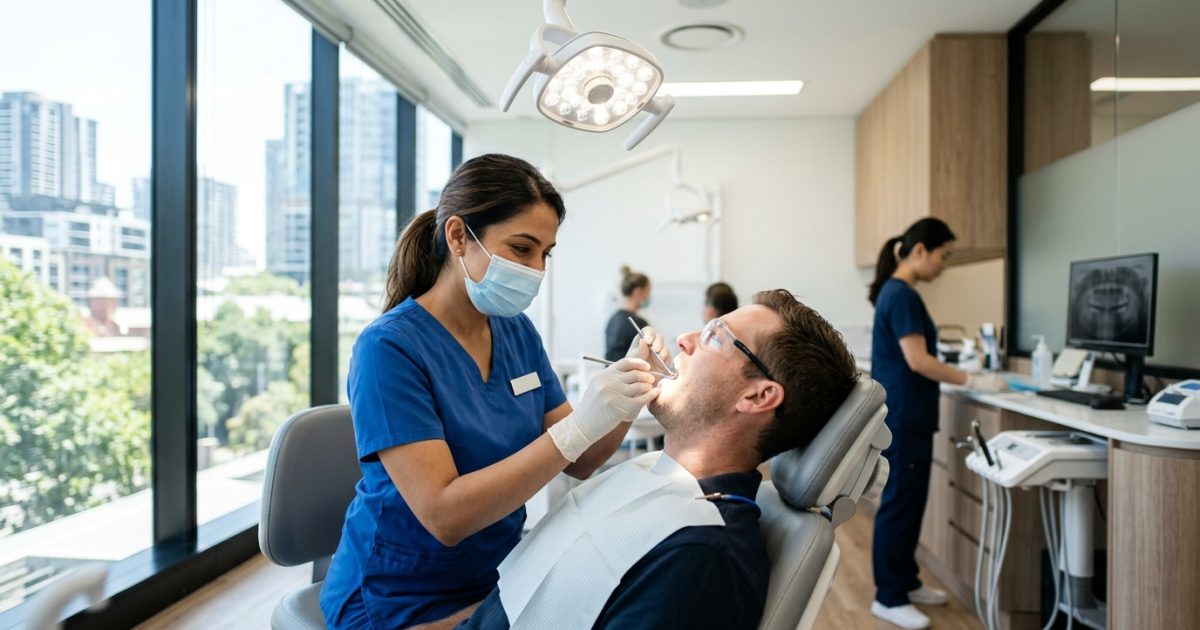
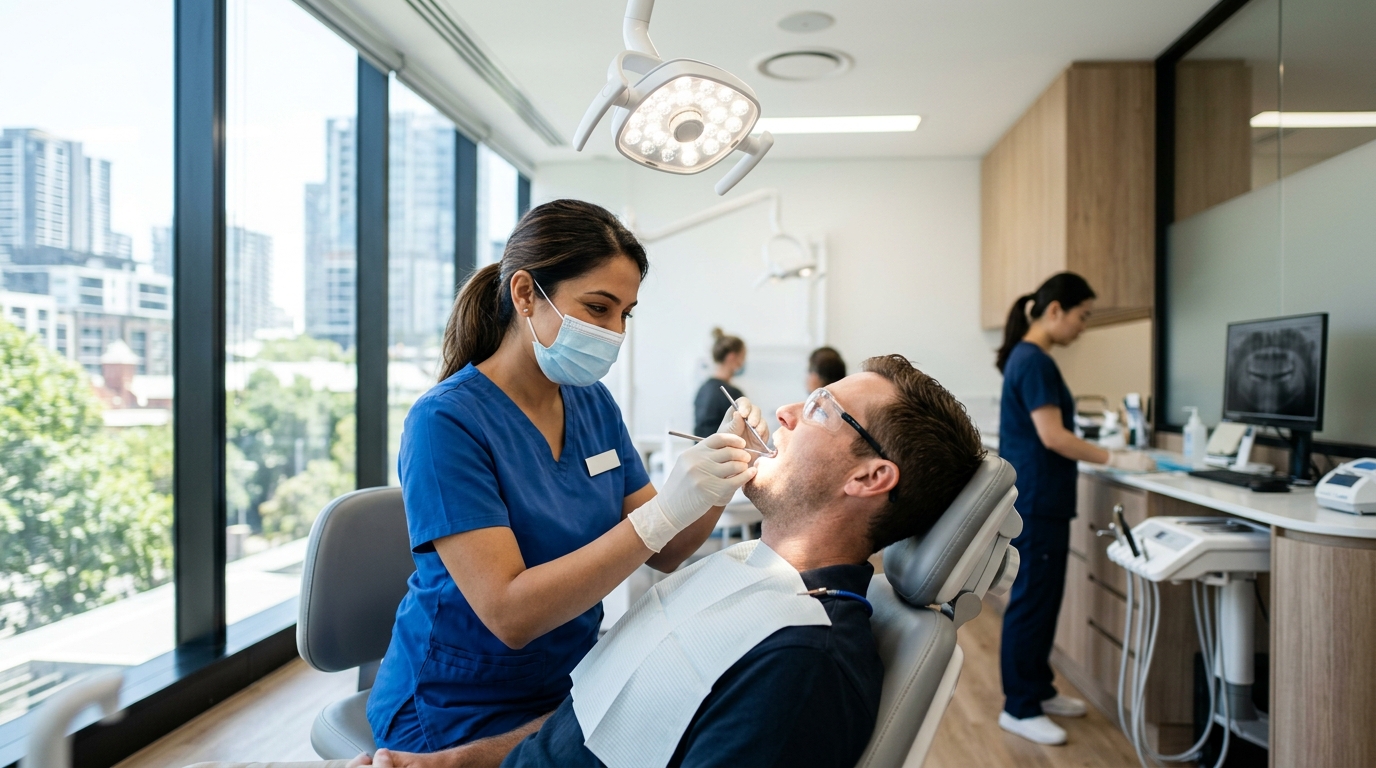
According to ADA fee survey data, a standard check-up (examination, scale and clean, and fluoride treatment) at a private Sydney practice typically costs between $220 and $380. A simple tooth extraction sits around $200 to $350, while a single tooth filling ranges from $150 to $400 depending on the size and material used. At the more complex end, a root canal treatment can cost $1,200 to $2,500, a porcelain crown $1,800 to $2,800, a dental implant $3,500 to $6,500, and full orthodontic braces $6,000 to $12,000. Teeth whitening performed in-clinic generally runs $600 to $1,200 in Sydney.
Sydney dentists consistently price above the national average, largely due to higher practice overheads, commercial rents in metro areas, and strong demand. A check-up that might cost $180 in a regional town can exceed $350 in inner-Sydney suburbs such as the CBD, Surry Hills, or Mosman. That said, community health centres and bulk-billing dental clinics operate across Greater Sydney and can reduce or eliminate out-of-pocket costs for eligible patients, including children aged 2 to 17 under the CDBS and concession card holders through state-run public dental services.
Price Breakdown by Service Level
| Service Level | What You Get | Typical Price Range (AUD) | Best For |
|---|---|---|---|
| Basic / Public | Check-up, scale and clean, basic X-rays, simple extractions via public dental or CDBS-eligible clinic | $0 – $180 | Concession card holders, eligible children, patients willing to join public waitlists |
| Standard Private | Full examination, scale and clean, fluoride treatment, bitewing X-rays, single-surface fillings | $220 – $500 | Adults with private health extras cover or those paying out of pocket for routine care |
| Premium Private | Crowns, root canal treatment, multi-surface fillings, wisdom teeth removal, tooth whitening, implants | $600 – $4,500 per procedure | Patients requiring restorative or cosmetic dental work at an established private practice |
| Specialist / Complex | Full implant placement, full orthodontic treatment (braces or aligners), periodontal surgery, oral surgery referrals | $3,500 – $15,000+ | Patients referred to dental specialists for complex or multi-stage treatment plans |
What Affects the Cost of Dentists in Sydney?
Location and practice overheads
Dental practices in Sydney’s CBD, eastern suburbs, and lower North Shore carry significantly higher rent and staffing costs than those in outer western or south-western Sydney. These overheads feed directly into the fee schedule a practice sets. Patients prepared to travel further from the city centre can often find the same quality of care at meaningfully lower prices.
Type of treatment and degree of difficulty
A single-surface composite filling on a front tooth is a very different clinical task from a multi-surface amalgam filling on a back molar, or a root canal followed by a crown. Dentists price each procedure according to ADA item numbers, which classify treatments by type and complexity. More steps, more chair time, and greater technical difficulty all push the fee higher.
Materials used
The materials your dentist selects make a substantial difference to cost. Composite resin fillings cost more than amalgam. All-ceramic or zirconia crowns cost more than metal-based ones. High-grade implant components from established manufacturers cost more than less-tested alternatives. Patients should ask their dentist to explain material choices and whether alternatives are clinically appropriate for their situation.
Private health insurance and rebates
Private health insurance with dental extras cover can reduce out-of-pocket costs, but the benefit you receive depends on your fund, your policy tier, and your annual limit. Major funds operating in Sydney include Bupa, Medibank, HCF, NIB, and HBF. Many practices offer HICAPS terminals for on-the-spot claiming. Annual limits typically reset each calendar year and are often capped between $500 and $2,000 for dental, so large treatment plans may still leave significant out-of-pocket costs. Preferred provider arrangements between funds and specific dental groups can also affect your rebate amount.
Government schemes and eligibility
The Child Dental Benefits Schedule (CDBS) provides eligible children aged 2 to 17 with up to $1,095 in benefits over two consecutive calendar years for basic dental services including check-ups, X-rays, cleaning, fissure sealing, fillings, root canals, and extractions. Eligibility is linked to receiving a relevant Australian Government payment such as Family Tax Benefit Part A. Adults holding a concession card may access reduced-cost care through NSW public dental services, though waiting times can be long. The Australian Government’s Medicare system does not cover general dental for adults outside of specific schemes.
How to Get Accurate Quotes
- Book an initial consultation and ask the practice to provide an itemised treatment plan with ADA item numbers before any work begins. This allows you to compare fees across practices and check your insurance rebates.
- Contact your private health fund before the appointment to confirm your remaining annual benefit and what rebate applies to each item number on the treatment plan.
- Request quotes from at least two or three Sydney dental practices for any procedure costing over $500. Fee variations between practices for identical item numbers can be substantial.
- Check whether you or your child are eligible for the CDBS through myGov, or whether you qualify for the NSW public dental service through a Health Care Card or Pensioner Concession Card.
- Ask about payment plans. Many Sydney dental practices offer interest-free payment arrangements through providers such as Zip or Afterpay Health, which can spread larger treatment costs over several months without adding to the total fee.
Red Flags to Watch Out For
- A practice that quotes a price verbally without providing a written, itemised treatment plan. Without item numbers, you cannot verify costs with your insurer or compare prices elsewhere.
- Unusually low prices advertised for complex procedures such as implants or crowns without clear explanation of what is and is not included. A quoted implant price may exclude the crown, abutment, bone grafting, or follow-up appointments, making the real cost far higher.
- Pressure to proceed with extensive treatment immediately after a first examination, particularly if the practice recommends multiple fillings, crowns, or other chargeable work without giving you time to seek a second opinion.
- No visible registration details for the treating dentist. All Australian dentists must be registered with the Dental Board of Australia, which is part of AHPRA. You can verify any dentist’s registration on the AHPRA website at no cost.
- Clinics that do not provide a written consent form or treatment agreement before beginning any procedure. This is a basic patient right and a professional obligation.
- Practices that cannot confirm upfront whether they have a HICAPS terminal or can process your fund’s rebate on the spot, making it harder to understand your actual out-of-pocket cost at time of payment.

Frequently Asked Questions
How much do dentists cost in Sydney on average?
For a standard private consultation including examination, scale and clean, and fluoride treatment, expect to pay between $220 and $380 in Sydney. X-rays add $50 to $160 depending on the number and type. Simple fillings range from $150 to $400. These figures align broadly with ADA fee survey data, though individual Sydney practices may charge above or below these averages. Public dental services and CDBS-eligible clinics can bring costs to zero for qualifying patients.
Why are some dentists prices so much cheaper?
Lower prices at some Sydney practices can reflect genuinely lower overheads, such as practices located in suburban areas with cheaper commercial rents or newer practices building a patient base. Some clinics offer reduced fees as preferred providers for specific health funds. Dental schools at universities such as the University of Sydney also provide supervised treatment at reduced rates. That said, very low prices on complex procedures can sometimes indicate the use of lower-grade materials, less experienced practitioners, or fees that exclude key components of the treatment. Always ask what is included.
Is it worth paying more for dentists in Sydney?
For routine care such as check-ups and cleans, a well-run practice charging mid-range fees will generally deliver the same clinical outcome as a premium-priced competitor. For complex restorative work, particularly implants, crowns, and root canals, the experience of the practitioner and the quality of materials used have a direct bearing on how long the treatment lasts and how well it performs. In those cases, paying a higher fee at a practice with demonstrated experience in the procedure and clear aftercare protocols is a reasonable approach. Checking verified patient reviews and confirming the dentist’s credentials through AHPRA helps inform that decision.
Dental care is one of the higher out-of-pocket health expenses Australians face, and Sydney pricing sits at the upper end of the national range. Getting an itemised quote, understanding your insurance position, checking government scheme eligibility, and comparing at least two or three practices before committing to significant treatment will put you in a much stronger position to manage costs without compromising on the quality of care your teeth and gums need.
For a curated list of top-rated providers, see our guide: Best Dentists in Sydney (2026).